Showing posts with label Mars. Show all posts

Tuesday, January 26, 2016

Will I Get Up Before Sunrise To See 5 Planets?


Today was one of those unexpectedly joyous days because my husband surprised me with a 4-day stargazing and hot spring-exploring trip to the California and Nevada deserts. We'll be heading for Pahrump, NV on Thursday and use that as a staging area for various night- / daytime forays and explorations. Death Valley is on the menu, and so is the Tecopa Hot Springs Resort.

Yet what I really look forward to - after 18 months spent in urban environs - is the lack of light pollution and unobstructed views of the skies. The weather looks favorable for the entire time and I'm hoping for spectacular celestial displays. Perhaps a glimpse of the Milky Way, which I have not seen with the naked eye since...oh,...let's just say a trip to the Canary Islands last century. 

I especially hope to get a great view of the current 5-planet alignment in the early morning skies:

Image credit: NASA / JPL-Caltech

In a rare alignment, Mercury, Venus, Saturn, Mars and Jupiter will form an arc in the pre-dawn southern skies, about 45 minutes prior to sunrise. In the CA and NV deserts, that's about 6:00 - 6:30 a.m. Antares in the constellation Scorpio will also join this early morning celestial dance, as will Spica, the brightest star in the constellation Virgo.

Image credit: Sky & Telescope

Another graphic of the early-morning planetary and celestial line-up that will remain visible until late February.


Image credit: New York Times

The diagram above shows that just because we can see five planets at the same time they are not the same distance away from Earth. The diagram illustrates the orbits of Saturn, Jupiter (planet name cut off in graphic), Mars, Venus and Mercury around the sun as well as the planets' relative distances from Earth. If I look at these five planets this weekend, and consider their relative distances from me, I wonder which one will appear brightest?

(Related science fact: Planets are not intrinsically bright. We can see them in the night skies because they reflect the light of our sun).
 

Finally, I wonder if I will be able to locate the new Starman constellation, named in honor of the late, great David Bowie, who showed all of us how to reach for the stars.

Image credit: The Weathernetwork
 
I'll already be looking for Mars and Spica, so maybe The Starman will reveal itself to me this weekend ~

Wednesday, December 26, 2012

My Coverage of STS-135 in Westfalen-Blatt (Bad Oeynhausen, Germany)


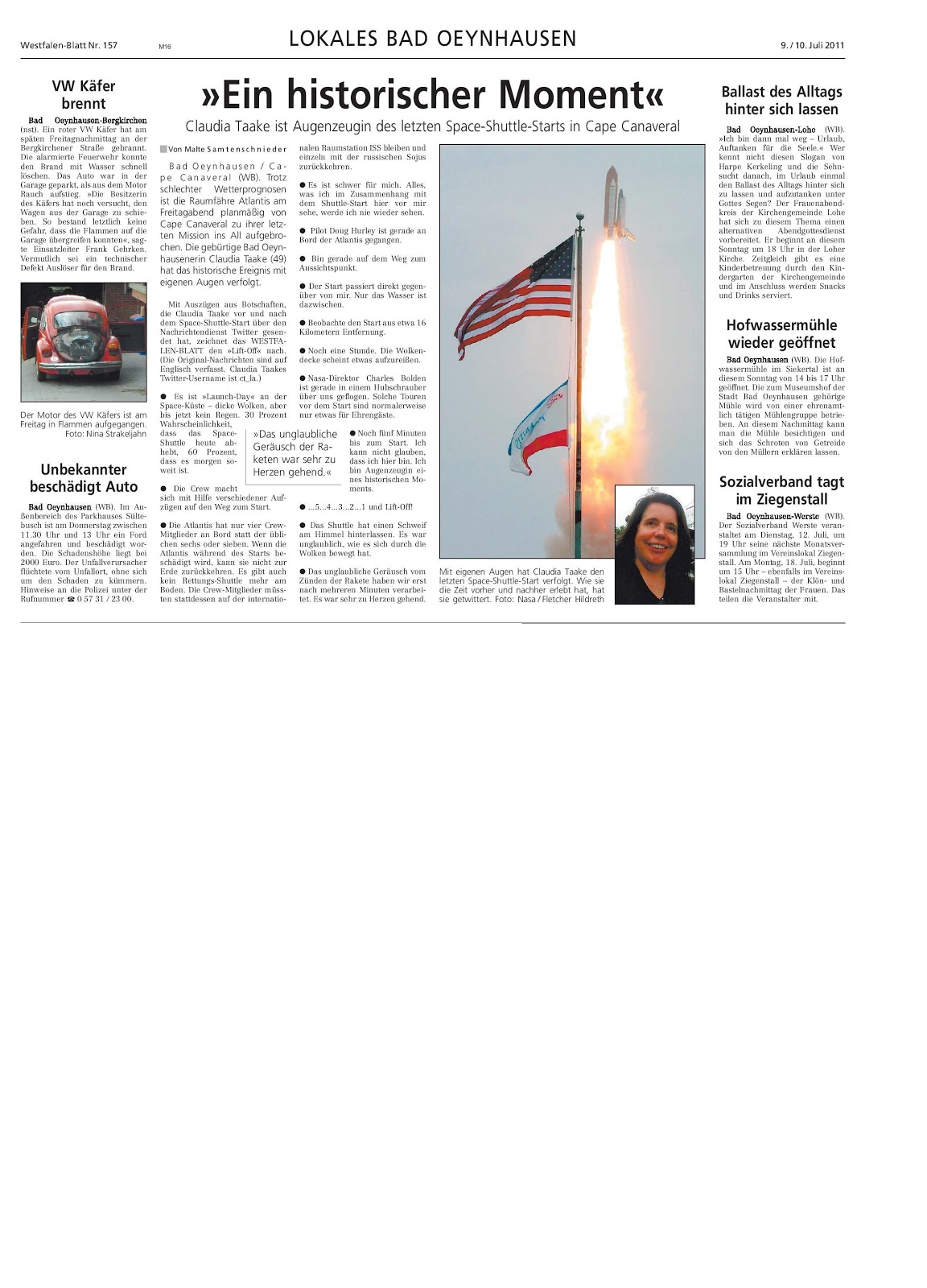
Being a spacetweep is all about outreach and inspiration via social media. When a German twitter follower of mine learned that I was traveling to Florida to witness the last Space Shuttle launch on July 8, 2011, he pointed out that many local Germans don't even know or care about the end of the Space Shuttle program. I decided to contact both papers in my hometown of Bad Oeynhausen to see if they wanted to interview me while experiencing STS-135 in person. Did they ever! I was asked for and promised exclusive coverage to the first paper that responded, the Westfalen-Blatt. I figured if I can reach, inspire or educate just one person in Germany, it would be worth the effort. I anticipated publication with some degree of trepidation and was pleasantly surprised. The journalist who interviewed me, Malte Samtenschnieder, did a great job. I was especially happy to see her translation of my STS-135 launch tweet stream in my hometown newspaper.

If you read German, you can see for yourself (scroll down to PDFs). If you don't, here are the Cliff Notes:

The first PDF page is the transcript of the interview with me a few days before my trip to the Space Coast. It was published pre-launch on July 8, 2011 and the picture on the right is actually of the last launch of Discovery on February 24, 2011 (STS-133). The interview mainly covers how I became a space geek and how NASA's social media activism, especially on twitter, has created a growing global community of spacetweeps and citizen scientists that will help launch the coming era of space tourism, private space exploration and permanent human colonies in low-earth orbit, the Moon, Mars and other solar system destinations. 

I also give a shout-out to Sonja Rohde, who is slated to become the first German space tourist and the first German woman in space. She is from my home state of Nordrhein-Westfalen. There are also sidebars with my biographical info and about the STS-135 mission profile and crew members. The interview was featured on the Westfalen-Blatt's front page.

The second PDF page is a second article by the same journalist published post-launch in the Westfalen-Blatt's weekend edition of July 9/10, 2011. It is a translation into German of my live tweets on launch day. While historic space events tend to cause cell phone and network outages due to overload, I got lucky. All my launch-related tweets got through, without delay. I even composed my launch tweet "...5 ...4 ...3 ...2 ...1 and Lift-Off!" ahead of time, with my finger on the "Send" button and my eyes on the launch pad. (Have I noted recently that smart phones are cooler than tricorders?). 

If you don't read German but follow my twitter feed - or space events, for that matter - you don't need a translation of the second article. I should add that the translation is very good and accurately captures what I was trying to convey. Except for one quibble that only matters to those who read both German and English. I tweeted about how shuttle launch sound waves are something you feel *viscerally*, in addition to seeing and hearing them - a feeling you just don't experience unless you're physically close to a couple million tons of propellants being ignited. The translation of "visceral" ended up as "zu Herzen gehend" (heartfelt), which is an ok translation, but not really what I said in English. It's a tough one, though, so I'm giving the translator a pass :)

Most of all, these articles are symbolic of what space activism and outreach is all about for me: It is about communication, passion, creativity and hope, the transcendence of national borders and cultural differences, and a focus on building a better future for all humankind.


Click here to read about my launch day experience in English.


Thursday, September 27, 2012

Water on Mars Revisited


From Giovanni Schiaparelli to Robert Heinlein the notion of water-filled "canals" on the surface of Mars was a popular one in science and science fiction during some of the late 19th and early 20th century. By the time I discovered science (fiction), the hypothesis of straight canals with flowing water on Mars had long since been dispelled. By the time I began to study Mars, Mariner and Viking had already sent back images from the Martian surface that meant I didn't have to imagine it. I could just look up the images. As I looked at Martian landscapes apparently devoid of any visible water, the notion of streams with flowing water on Mars appeared quaint and naive. 

Now, Curiosity has sent back images from Gale Crater that contain evidence of ancient, quick-flowing water on Mars. NASA's newest rover on the Red Planet found a tilted block of rock that is part of an ancient streambed, along with gravelly rocks whose shape and size indicate they were formed by having been tumbled in water, for a long time. The gravel is too heavy to have been shaped by wind. This is the first time that water-transported gravel has been found on Mars.


Evidence of an ancient streambed on Mars (left), compared to a similar formation on Earth


The size and shape of the gravel also provides clues about flow rate and duration: The water was between ankle- and hip-deep and flowed at a rate of 3 feet (1 meter) per second. That is a pretty brisk-moving stream. When water did flow on Mars in this location, it flowed for a very long time, a very long time ago.

We are certain to find additional clues as Curiosity continues its journey towards the Glenelg area of Mt. Sharp on Mars. In the meantime, I am left with a whole new, awesome dimension of Martian geological history. While Gale Crater was picked as the rover's landing site partly because orbital data indicated the presence of an alluvial flow, I have to ask: If Curiosity practically landed in an ancient Martian streambed, how common was water on Mars back when Gale Crater sported at least one knee-deep, briskly moving stream of water? Was it common or rare? Did the flowing water environment support any life? What happened to the planet between then and now? How did it change from an environment supporting liquid water to what it is today? Where did all that water go? 

We may not have reliable answers to these questions for a while but the fact that we can now ask them and look for clues in data directly from the Martian surface is a spectacular achievement of planetary science. 

Go Curiosity!

For my coverage of Curiosity's landing on Mars from Planetfest 2012, click here and here

For my coverage of the NASA/JPL tweetup featuring Curiosity in June 2011, click here


Tuesday, September 18, 2012

~ What I See On Mars ~


Ever since this jaw-dropping panoramic view from Curiosity became available last month, I have been exploring it at least once a day.

http://www.panoramas.dk/mars/greeley-haven.html
(Copyright: Hans Nyberg, panoramas.dk)


And still, I see something new each time I look at it. 

I see a stunning landscape, on another planet, alien, yet hauntingly familiar.

I see a robot from Earth, a marvel of human accomplishment and ambition, an electronic ambassador to a planet that will have a human presence in most of our lifetimes.

I see a vista of Mars that no human eyes have ever taken in before. 

I see colonies, settlements, domes, tented canyons, rovers, landers, power plants, space elevators, greenhouses and playgrounds.

I see humans from Earth utilizing the sum total of human scientific and technological advancements to build new lives on Mars, to begin again in ways we cannot on Earth.

I see communities, villages, cities, centers of commerce, with names such as Bradbury Landing, Endeavour, Heinlein Station, B5, Tatooine, Elysium, Roddenberry Center, Chandor Chasma, Mars Prime, Argyre, Chryse and Noctis Labyrinthus Overlook.

I see Olympus Mons, a volcano of a size and scale almost beyond the comprehension of human dimensions.

I see two moons in the sky at night, and the same sun as on Earth, but dimmer, fainter, much, much colder.

I see Mars populated by millions of humans - not nearly enough to create much of a crowd on a planet with so much land and no oceans.

I see generations of Martian-born humans, clearly descendants of Earth, yet separate and distinct as they evolve and adapt to live in a Martian environment, Martian atmosphere, Martian climate, a true Martian culture.

I see that culture reach out and travel beyond Mars, to the asteroid belt, to Titan, Io, Europa, and on. 

I see the day when we find a way to travel or project ourselves through interstellar space with billions of galaxies to explore.

And it all begins on Mars.

For we are human. 

We are explorers. 

We are curious, and we will go.

What do you see?

Monday, September 17, 2012

Stunning Visuals - Mars Curiosity and PlanetFest 2012


By now, Curiosity has already sent back a treasure trove of thousands of images. They are all archived and accessible here, with new images added daily.

Below is a collection of images and videos that are among my personal favorites so far. Enjoy.


This is the very first image from Mars Curiosity, sent within minutes of the rover's touchdown. One of the wheels is visible in the lower right. We saw this live at Planet Fest 2012 in Pasadena on August 5, 2012, as the image came in. 

If you look below, just to the left of the center on the horizon, you will note what looks like three dots, one sitting on top of the other two, which in turn touch the horizon. Astute observers of this initial image noted that this feature was not in comparable images taken by Curiosity later on. The initial buzz over this discrepancy soon calmed down, as NASA confirmed that what we're looking at in the image below is the dust plume thrown up into the Martian atmosphere upon Skycrane's impact. That is why this "feature" is no longer visible in later images.


The Mars Reconnaissance Orbiter (MRO), which is orbiting Mars, used its HiRISE instrument to snap this picture of Curiosity under its descent chute, just prior to touchdown on Mars at Bradbury Landing:


One of the most stunning images that Curiosity has sent back so far, is this interactive panoramic view of Bradbury Landing and Gale Crater. Click and explore the surface of Mars in color! (Copyright: Hans Nyberg, panoramas.dk)

http://www.panoramas.dk/mars/greeley-haven.html


Everyone who has been following Curiosity's wondrous journey, has seen this NASA video, dubbed "7 Minutes of Terror", which details the intricacy, complexity and engineering precision required to land Curiosity on target and intact:


And then, of course, there is this spoof video (not made by NASA) that quickly went viral. You'll see why (if you haven't already).      


Finally, a friend and I having fun inside one of XCOR's Lynx 2-seater space plane mockups at PlanetFest:       


Sunday, September 16, 2012

Planet Fest 2012 - Curiosity Has Landed!


When was the last time you were part of a crowd of 3,000 people cheering wildly and chanting the name of a government agency for minutes on end?

Yeah, that had never happened to me either - until the evening of August 5, 2012, around 10:30 pm PDT at Planet Fest 2012 in Pasadena, a weekend-long celebration hosted by The Planetary Society that culminated in Curiosity's landing on Mars. I was at Planet Fest with a friend. About an hour before the scheduled landing time we had secured two seats in the second row from the front in one of two large auditoriums with several over-sized screens that allowed us live views of the JPL control room and let us interact with other Curiosity Celebrations around the world: Canada, Australia, Times Square. The whole world was watching.

As 10:30 pm drew closer, we endured a nail-biting wait as Curiosity performed a picture-perfect landing at Gale Crater. One after another - with a 15-minute time delay due to the distance between Mars and Earth - Curiosity hit every milestone of her entry, descent and landing phases. 

Bruce Betts was on stage with Bill Nye, who had engaged, entertained and interacted with the audience all evening. In the final minutes of the landing phase, as we awaited the signal that Curiosity was safely on the ground, both Bill Nye and Bruce Betts were riveted to the screens, their backs turned to the audience. Then we heard the signal - Curiosity was on the ground, on another world! 

The cheers and jubilation that ensued were a wonder to witness and experience. At first it was clapping, cheers and yells, then a few "USA! USA! USA!" emanated from the crowd, which quickly morphed into "JPL! JPL! JPL!". The entire audience joined in for several minutes. I was literally jumping up and down. 

It came as a total surprise to me when I suddenly found myself face to face with a cameraman and a reporter, who thrust an ABC 7 microphone into my face and said: "You seem pretty excited. What do you think?" I am usually very, very reserved around news media, especially broadcast media, so I don't know what came over me that night. I yelled "I think this is the most exciting thing humans have ever done!" into the mic. (Yes I know that's arguable. But I was biased. We'd just landed a giant freaking nuclear-powered robot with lasers on Mars!) In retrospect, I overdid it for the camera. I don't believe ABC 7 ever aired my excited outburst, whereas my friend, who wasn't quite acting as much as a madwoman as I was, found herself all over the local evening and morning news.  

So yes, I flubbed my chance to reach a large TV audience that night with a pithy sound bite because my excitement got the better of me. I don’t ever apologize for my enthusiasm for space exploration. But next time a TV reporter sticks a microphone into my face and asks me to comment on a planetary science mission, I will know exactly what to say and how to say it so that I will actually get some air time!


Saturday, May 19, 2012

T - 90 Minutes And Counting ~


As I write this, it is exactly T - 90 minutes from the scheduled launch time for Space X's demonstration mission to the International Space Station. A Falcon 9 rocket with its Dragon capsule payload is slated to lift off from Pad 40 at Kennedy Space Center at 1:55 a.m.

Space X is poised at the brink of making history. A successful mission means Space X will become the first private entity on the planet to not only achieve orbit, but to dock with the ISS. The symbolism of this feat cannot be overstated at a time when NASA is reeling from funding cuts and the iconic Space Shuttle will never fly again. 

More importantly, Space X has ambitious plans that go far beyond the symbolic. The Dragon capsule can function as a reusable spacecraft to carry astronauts to the ISS and beyond. Space X founder Elon Musk envisions manned missions to Mars within the next 10 years and a burgeoning space tourism industry that will offer round trip rocket rides to space stations, habitats and other future destinations in low Earth orbit and beyond. 

Within the next 20 years, space travel, space ships and suborbitals will become as commonplace as air travel and aircraft. We have finally reached the dawn of an era that will make space accessible to those who want to experience it, on a large scale.  90 minutes from now, Space X is set to pave the way!

Go Space X!

Go Falcon!

Go Dragon!


Tuesday, February 28, 2012

Curiosity: Meeting Mars Science Laboratory at JPL


On June 6, 2011, I was one among 120 @NASA Twitter followers who were invited to spend a day behind the scenes at a NASA Tweetup at Jet Propulsion Laboratory in Pasadena.

This was my first NASA Tweetup and the second held at JPL, which hosted the first one in January 2009. Now, three years later, there are Tweetups hosted at various NASA facilities just about every month, in addition to many space-themed Tweetups organized by Twitter space enthusiasts not affiliated with NASA, a group that has christened itself #spacetweeps.

Immersion in Tweetups and related social events has been a tremendous inspiration for me. It rekindled my life-long passion for space, space exploration and space tourism in a setting that allows me not only to geek out to my heart's content, but to be part of a fast growing community of people who all want to see humans get off our planet and establish a permanent presence beyond low-Earth orbit. Not 100 years from now. Not 50 years from now. But NOW, in our lifetime.

I have yet to meet anyone at a NASA or space Tweetup who does NOT want to go into space. To illustrate just how much we do, an informal poll I took at a gathering of spacetweeps last July revealed that 80% answered Yes when offered this scenario: "You are given the opportunity to live on a Mars Colony in your lifetime. The trip is one-way. Would you go?"

I don't think NASA expected its Tweetup campaign to evolve into the social phenomenon, online and off, that it has become. Still, the credit certainly belongs to NASA and its social media specialists for creating a highly effective public outreach campaign, at a time when the agency's 30-year Space Shuttle Program drew to a close and NASA faced significant changes in its operations, staffing and priorities.

When I arrived at JPL on June 6, 2011, I expected to experience great things and meet people who would become friends. I was not disappointed. NASA Tweetup day at JPL stands out as one of my most memorable days of the year.

The highlight of the day was a tour of the JPL facility where Mars rover Curiosity was in its final stages of assembly, with preparations underway to ship the rover to Kennedy Space Center for its November 2011 launch. When I look at the pictures from that day, I marvel that this machine is now well on its way to the Red Planet. Curiosity will reach Mars orbit in August 2012.

The rover impressively outclasses its predecessors: Curiosity is the size of a car and weighs in at a ton. It is nuclear-powered and its many scientific instruments include a laser that can vaporize Martian rock. In a major design innovation, Curiosity won't have to bounce off the Martian surface encased in giant balloons to land in a most undignified manner. Befitting a robot of its sophistication, it will instead be lowered by a sky crane that uses retro rocket and tethers to guide Curiosity to its destination at Gale Crater while hovering above the Martian surface.

A flawless launch atop an Atlas V rocket on November 26, 2011 saw Curiosity off on an 8-month-trip to Mars:


I expect to see NASA Tweetups and space meetups around the world later this year as we celebrate Curiosity's arrival in Mars orbit and track the rover's descent onto the surface of another world. Nuclear-powered, laser-equipped and all that, Curiosity does have a whimsical side as well. The wheels have a tread pattern that spells out J-P-L in Morse code wherever Curiosity travels on the Red Planet. 

At the Tweetup, we were invited to sign a guest list, an image of which is on its way to Mars with Curiosity, along with a million others. I bet I'm not the only one who signed the list who has wondered about future colonists who will encounter Curiosity on the Martian surface and scan that list for the name of a relative or friend.


Mars Rovers Family Portrait:


Curiosity is on the right, Spirit/Opportunity is on the left, and the smallest one is a model of Sojourner, which launched to the Red Planet in 1997. Spirit and Opportunity arrived in 2003. Both Spirit and Oppy were designed to explore Mars for 90 days. Spirit remained operational until the summer of 2011 and Opportunity, roving strong now in its 9th year, is still sending back data.

You can track Curiosity's progress to the Red Planet here in real time:  
Where is Curiosity?


~ Imagine Mars ~

One of the purposes of this blog is to showcase noteworthy news, achievements and aspirations of people other than trained astronauts in the areas of space flight, space tourism and space exploration.

Pamela Greyer is a teacher in Chicago. I first met Pam in June 2011; before that, I knew her on twitter as @TheNasaLady. We met at Jet Propulsion Laboratory in Pasadena, where I attended my first NASA tweetup. I will describe that life-changing event in a future post. This one is dedicated to Pamela and her students’ remarkable achievements.

The previous summer, Pam had worked with some of her teenage students on the “Imagine Mars” project. Students were challenged to think about and imagine the requirements and realities of establishing a Mars colony and maintaining a human presence on Mars. Pamela’s students worked on all the aspects of a Mars colony, from the basics of survival, sustainability, habitats, oxygen, food / water supply and waste disposal to a deeper understanding of conservation of resources, recycling and green technology. At the end of the project, something amazing happened: Students took the initiative; they wrote and performed a rap song entitled "Bye, Bye Earth" about Mars colonization and made this video:


About half way through the NASA JPL tweetup last June, tweetup organizers played this video for the attendees. The reaction was a joy to behold: Spontaneous cheering and applause that culminated in a standing ovation.

For anyone who has any doubts that we WILL go to Mars and establish colonies there, watch this video and you will reconsider.

For those of us who have no doubt, the questions isn’t if we will go, but when.