Showing posts with label Space X. Show all posts

Saturday, February 7, 2015

DSCOVR Will Launch - Falcon 9 Plans Landing


Update - February 11, 12:15 pm:

Today's DSCOVR launch attempt is still on track for 3:03 pm PST. NASA and SpaceX will have live feeds.

Unfortunately, SpaceX will not attempt to land the Falcon 9 upper stage on a barge today due to extreme weather in the Atlantic. SpaceX reports 3-story-high waves crashing over decks and says the company plans a soft water landing through the storm to collect valuable landing data.

Please scroll down for more information about the DSCOVR mission and landing attempt.

_______________________________________________________________________________

Update - February 10, 3:00 pm:

Launch was scrubbed today due to persistent upper level winds just above the safe margin. Next attempt will be tomorrow:

Wednesday, February 11, 3:03 pm PST (6:03 pm EST, 00:03 Feb.12 CET).

________________________________________________________________________________

Update - February 9, 8:00 am:

NOAA tweeted this morning that launch will be delayed one more day due to unfavorable weather conditions. New launch time: 

Tuesday, February 10, 3:05 pm PST (6:05 pm EST, 00:05 Feb.10 CET).

A backup launch window is available on Wednesday, February 11, 3:03 pm PST (6:03 pm EST, 00:03 Feb.12 CET).


_______________________________________________________________________________

Update - February 8, 3:20 pm

Today's launch was scrubbed three minutes prior to lift-off time. According to spaceflightnow.com: "The Air Force Eastern Range called a hold due to a loss of tracking with the rocket. The SpaceX launch team was also working a telemetry problem in the final minutes of the countdown, and it's not clear if both conditions were "no go" for launch."

The launch window was instantaneous and there won't be another attempt today. Falcon 9 is being put in safe mode. SpaceX will try again tomorrow:

Monday, February 9, 3:05 pm PST (6:05 pm EST, 00:05 Feb.10 CET). 
Weather conditions are about 50% favorable. A backup launch window is available on Wednesday. The 1-day delay will also give SpaceX a chance to replace a video transmitter on the rocket's first stage.

__________________________________________________________________________________


Tomorrow, February 8, Space X will launch the Deep Space Climate Observatory (DSCOVR) for NASA, NOAA and the U.S. Air Force. This launch has been delayed a few times throughout January and is now scheduled for 3:10 pm PST (6:10 pm EST, 00:10 Feb. 9 CET). In North America, we'll see a Sunday afternoon launch from Cape Canaveral. NASA TV and SpaceX will have live coverage.


 NASA / NOAA / USAF DSCOVR Mission Patch

Nine minutes after launch - and this time in daylight - the Falcon 9's first stage will prepare to land on SpaceX’s autonomous spaceport drone ship in the Atlantic. The private rocket company tried this maneuver for the first time last month - an almost-nailed-it landing attempt that ended, as Elon Musk tweeted, with a full RUD event - rapid unscheduled disassembly. Sunday's landing attempt on a drone ship, if successful, will mark a historic occasion in the history of rocketry. You can find more details about the launch and landing timeline here.
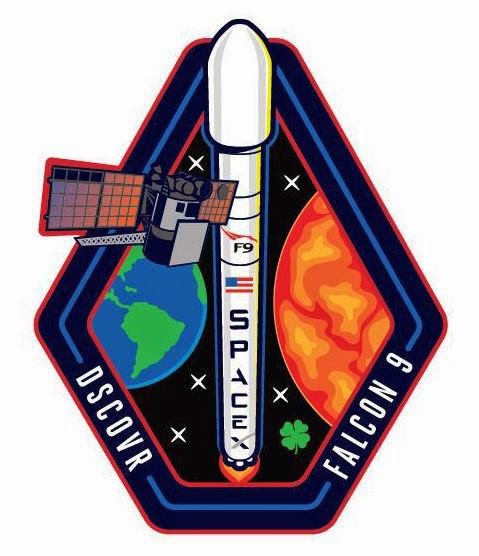


  SpaceX DSCOVR Mission Patch


The DSCOVR satellite will be positioned 1 million miles (1.6 million km) from Earth, and about 90 million (145 million km) from the Sun at the L1 libration point, where the gravitational influence of the Sun and the Earth are exactly balanced. This places DSCOVR into a stable orbit, where the satellite will monitor space weather, such as solar winds that can affect communication grids and other equipment on Earth. DSCOVR is also tasked with Earth observing functions. Read more about DSCOVR here.


 Photo credit: NASA

Getting ready for launch: Enclosing DSCOVR in the Falcon 9's 43-foot-tall (13 m) payload fairing.


Tuesday, October 29, 2013

Exhilarating Maiden Launch of Falcon 9R from VAFB


For a month, from late August to late September this year, I tracked the launch preparations for SpaceX's maiden launch of its Falcon 9R rocket from Vandenberg Air Force Base in Lompoc, CA. I published updates and photos on this blog. After multiple delays throughout the month, the launch date was set for September 29, 2013, with a launch window of 9-11 a.m. PDT, and a second possible window 24 hours later.

The launch was breathtakingly beautiful and occurred as soon as the window opened, on a perfect Sunday morning, under brilliantly blue skies - which is rare for summer mornings at VAFB, where fog and low clouds are common.


This was SpaceX's first launch from its home state of California.

Here is a video with a sequence of photos we took as we watched Falcon 9R and Cassiope ascend into orbit. After the launch, we did some reconnaissance around the area and discovered a public viewing area that put us 5 miles closer to the launch pad.


This was our vantage point from Providence Landing Park in Lompoc, about 10 miles from the launch pad. The top of Falcon 9R is peeking out from behind the hill.


Close-up of the above view, just before launch.


View towards the launch pad on Launch Day Eve from Providence Landing Park.


We have lift-off! Falcon 9R soars skyward!


We missed filming the very first seconds of the launch, mainly because it took us by surprise. After all the delays, we expected to settle in for a wait. But Falcon 9R had other plans! The sound waves of the launch take 25 seconds to hit the camera.


Contrail from Stage 1 separation as Falcon 9R keeps climbing 


Eventually, the contrail started to look like a ferret jumping over a cloud! 
Also in this photo: Spot the crescent moon!


Weather and visibility the very next morning at the same time. 
The weather cooperated perfectly for Falcon 9R's maiden launch from VAFB!


Photo and video credit: Bradley Falk 


Saturday, September 21, 2013

Amazing Videos ~ Grasshopper, Cows, Rocket Frog and Space Bat


I have previously written about SpaceX's Grasshopper Vertical Takeoff Vertical Landing Vehicle. The most recent test takeoff / landing has left us with some truly jaw-dropping footage. In August of this year, Grasshopper reached an altitude of 820 ft (250 m) with a 328 ft (100 m) lateral divert maneuver, and then returns to the center of the launch pad. 

This technology is instrumental for the development of reusable rockets, both manned and unmanned, for landings and takeoffs on Earth and on off-planet destinations in our solar system. 


Video credit: SpaceX
Grasshopper test launch and landing with 100-meter lateral divert maneuver


Video credit: SpaceX
 Stampede!

A different camera angle shows that we've also got cows! Launches and landings are rough on the wildlife and farm animals.   


Let's have a moment of silence for Rocket Frog:  
 
  Image credit: NASA Wallops

This unlucky frog became a viral video sensation after NASA's recent LADEE launch to lunar orbit.


 Let's not forget Space Bat: 


On March 15, 2009, Space Bat launched to instant fame on STS-119 Discovery from Kennedy Space Center.


Thursday, September 20, 2012

SpaceX, Santa Maria & Space Coast West


While Mars rover Curiosity, Space Shuttle Endeavour and NASA have been getting most of the media attention lately, SpaceX has been busy. 

The company announced today that it is targeting October 7 as the launch date for its first cargo supply flight to the International Space Station under contract with NASA. Space X's Dragon supply craft will launch from Kennedy Space Center in Florida. 

Meanwhile, in California, SpaceX's official signage went up at Vandenberg Air Force Base north of Los Angeles. SpaceX is building its own launch pad there designed to launch both crewed and robotic spacecraft into orbit - and beyond. 


Photo credit: SpaceX

SpaceX's brand-new sign at Vandenberg Air Force Base

This is not the first time that ambitious plans have been forged for VAFB's launch capabilities. I discovered this the last time I visited the Santa Maria Museum of Flight, near the base. One of the retirees working there as a volunteer museum guide shared interesting details with me regarding VAFB's role as a future space shuttle launch site that first emerged in the late 1970s, as the shuttle concept was being developed. 

He showed me group photos of engineers in front of a shuttle mockup, signed posters, starting to yellow with age, of Enterprise in flight position on a launch pad at Vandenberg, taken years prior to the first actual shuttle flight in 1981. He also showed me a heat tile from the doomed shuttle Challenger, acquired by the Museum as a reminder of what could have been. 

By the time Columbia made its successful maiden voyage into orbit and back again, Santa Maria was already positioning itself to become the city behind Vandenberg, a community ready to welcome an influx of skilled labor, money, vitality and tourism. During the early 80s, NASA was planning to expand its shuttle launch capability to VAFB, to create, in essence, a Space Coast West location. The people of Santa Maria were eager to step into that role. 

Those hopes and dreams, like so many others, were dashed in an instant due to the Challenger disaster in 1986, as NASA cancelled plans to launch the space shuttle from Vandenberg.
Space Coast West never came to be. 

Until now. 

SpaceX has revived this dream, as the company is planning an ambitious launch schedule, both from Kennedy Space Center and Vandenberg. Santa Maria looks like it is perched at the brink of reviving its dream to re-invent itself as a city rooted in the excitement, promise and economic boon that is spaceflight. 

As far as I know, the only space shuttle that has ever been at Vandenberg was Enterprise, never meant to fly in space. Please let me know if you know of any other shuttles that have been at Vandenberg for any reason. 


Saturday, May 19, 2012

T - 90 Minutes And Counting ~


As I write this, it is exactly T - 90 minutes from the scheduled launch time for Space X's demonstration mission to the International Space Station. A Falcon 9 rocket with its Dragon capsule payload is slated to lift off from Pad 40 at Kennedy Space Center at 1:55 a.m.

Space X is poised at the brink of making history. A successful mission means Space X will become the first private entity on the planet to not only achieve orbit, but to dock with the ISS. The symbolism of this feat cannot be overstated at a time when NASA is reeling from funding cuts and the iconic Space Shuttle will never fly again. 

More importantly, Space X has ambitious plans that go far beyond the symbolic. The Dragon capsule can function as a reusable spacecraft to carry astronauts to the ISS and beyond. Space X founder Elon Musk envisions manned missions to Mars within the next 10 years and a burgeoning space tourism industry that will offer round trip rocket rides to space stations, habitats and other future destinations in low Earth orbit and beyond. 

Within the next 20 years, space travel, space ships and suborbitals will become as commonplace as air travel and aircraft. We have finally reached the dawn of an era that will make space accessible to those who want to experience it, on a large scale.  90 minutes from now, Space X is set to pave the way!

Go Space X!

Go Falcon!

Go Dragon!