Showing posts with label International Space Station. Show all posts

Sunday, April 10, 2016

Dual Success For SpaceX


It's been a weekend of amazing successes for SpaceX. The private space company delivered its eighth Dragon resupply capsule to the International Space Station and stuck an experimental landing of the spent Falcon 9 booster rocket on a drone ship in the Atlantic. SpaceX has previously tried landing the first stage of a Falcon 9 used in missions. Both times, the rocket made it to its target on the drone ship, but failed to land upright, resulting in RUD events (rapid unscheduled disassembly).

This tweet from early Sunday morning, April 10, shows Dragon safely docked to the ISS Harmony module, next to an Orbital Sciences' Cygnus cargo craft and a Soyuz crew capsule on the lower right. In total, six spacecraft are currently docked to the International Space Station.


But let's go back to launch day, Friday, April 8, and take a look at all that SpaceX accomplished this weekend:


Image credit: SpaceX
Falcon 9 with its Dragon payload on the launch pad at Cape Canaveral


Image credit: SpaceX
Mission patch for SpaceX's eighth commercial resupply mission (CRS-8) to the International Space Station

If you look closely, you'll find the patch full of interesting details. For example, the eight stars in the design represent the eight missions to the ISS that SpaceX has flown so far, with one star dimmed out to symbolize last June's failed launch.


Image credit: SpaceX
Close-up of Dragon capsule atop Falcon 9, which stands over 200 feet (60 m) tall


Image credit: Space X
Graphic illustrating the stages of launch, landing and mission completion (click to enlarge)


The drone ship name in the above graphic is Just Read The Instructions. The ship on which Falcon 9 stuck its historic landing is Of Course I Still Love You.

The following trio of still pictures captured by SpaceX's chaser plane near the drone ship shows the landing's most breath-taking moments. This is the first time that SpaceX has successfully landed a rocket used in a mission on a drone ship at sea. The private space company previously succeeded at landing a Falcon 9 first stage on-shore.


Image credit: SpaceX

Image credit: SpaceX

Image credit: SpaceX

Whether Falcon 9's first stage lands on a drone ship or on shore after delivering a payload depends on several factors. Elon Musk explained some of them on Twitter.


Following are two tweets from SpaceX with landing video clips that were posted to the company's twitter account within hours of the landing.


Here is SpaceX's 36-minute launch and landing live webcast. About 30 seconds in, a legend appears at the bottom that lists the consecutive events being covered. It is well worth the time to review the launch and what SpaceX labeled "experimental landing". While the landing is one of the most jaw-dropping and certainly the most historic aspect of the CRS-8 mission, a successful landing was not the primary mission objective. That was getting a Dragon resupply capsule, including its important science cargo, safely to the International Space Station. SpaceX succeeded on both counts, with several cherries on top.

The reactions from employees at SpaceX headquarters in Hawthorne, CA after the successful launch and landing on Friday say it all. Elon Musk and the team at SpaceX have mastered another crucial step towards routine usage of reusable rockets, drastically lowering the cost of reaching targets in orbit and beyond and making space more accessible than ever before. SpaceX plans to re-fly a used rocket within a few months.


Video credit: SpaceX
Live webcast from SpaceX's headquarters during Friday's successful launch to the ISS and landing on one of the company's drone ship.


Below is the Storify of my live tweets and conversations during Friday's pre-launch, launch and landing events, with some additional remarks for this blog post.

Sunday, December 28, 2014

Earth Photos From The ISS Are Full of Surprises


One reason I love twitter, tweeting and tweeps is that I learn so much simply by doing something I enjoy. Hardly a day goes by that I don't learn something new. Here is today's discovery.

This morning, Sam Cristoforetti @AstroSamantha, who is currently aboard the International Space Station, tweeted a picture of the Hawaiian Island O'ahu with Honolulu clearly visible.


I retweeted this to my own timeline without noticing the odd coloration of the ocean at the top and at the left side of the picture, most likely because I initially saw a small version of it on my phone. 

Shortly thereafter, Frank Benson @mfbenson1 brought up this excellent question:


I took a second look at the picture and suggested we might be looking at some very thin, low cloud cover, since mud or sediment don't make much sense, given local geography. Clouds were my best guess, but since I didn't know for sure I included Peter Caltner @PC0101 in the conversation, who is a veritable fount of useful and factual information about pictures of Earth taken from the International Space Station. Turns out Frank and I had both guessed wrong:


Peter then tweeted a photo taken from the ISS that shows an example of extreme sun glint, so much so that the brightness 'wipes out' the colors of the land.


He added that glint pictures can be extremely useful, since they show coastal inlets and river courses better than aerial views. The ISS orbits at ca. 220 mi (350 km) above Earth.


Thanks, Peter, for this really cool lesson in orbital photography effects!


Tuesday, December 16, 2014

SpaceX's Jan. 10 CRS-5 Launch Includes Precision-Landing Upper Rocket Stage On Barge


Update - January 8: SpaceX's CRS-5 resupply mission to the ISS has been postponed to Saturday, January 10, 1:47 a.m. PST (10:47 CET) - a weekend night launch. I'm sure other West Coast night owls like myself will stay awake to watch and live tweet the launch, given the historic nature of this mission. NASA TV will provide live coverage, starting at 12:30 a.m. PST (9:30 CET). Details about this mission are below the Update sections.


Update - January 6: Today's launch attempt was scrubbed at the last minute due to a problem with an actuator assembly, a part of the rocket's second stage engine steering system. The next launch attempt is scheduled for Friday, January 9, at 2:09 a.m. PST (11:09 CET) - an almost reasonable time for us West Coast night owls. SpaceX is characteristically stingy with details; Elon Musk posted this tweet today:


Update - December 18: Due to issues with a static fire test this week, SpaceX has moved the launch date to January 6, 2015, at 3:18 a.m. PST (12:18 CET).


Delayed multiple times since September, SpaceX's cargo delivery to the International Space Station is scheduled for January 10, 1:47 a.m. PST (10:47 CET), launching a Dragon cargo capsule atop a Falcon 9 rocket from pad SLC-40 at Cape Canaveral. This mission will be the private space company's fifth cargo delivery to the ISS under NASA's Commercial Resupply Services contract. 

The mission is named CRS-5 and here is its patch. I like how the launch state of Florida is marked in a lighter blue color. Naturally, the traditional SpaceX clover leaf is there as well. What I like most about it is that Falcon 9 is practically bursting out of the confines of this beautiful patch, conveying anticipation, excitement and confidence in what's ahead. The Dragon capsule on the right has already found a way to escape its patch boundaries, but, hey, that lucky capsule is going to the International Space Station, so Dragon's impatience is quite understandable!


For SpaceX, CRS-5 is quite a bit more than another supply run to the ISS, as the company will further test re-usability functions and performance of its flagship Falcon 9 rocket. From its inception, SpaceX has aimed to make spaceflight more affordable and accessible. Reusable rocket stages are a crucial factor in the quest to develop rockets that are significantly cheaper to fly than their single-use counterparts. Notice the upside down V-shaped structures on the rocket in the patch - or, from a Trekkie's perspective, the Star Trek emblem-shaped structures affixed to this Falcon 9 stage. These are Falcon 9's landing legs for attempting a soft landing on a spaceport barge.

On a mission earlier this year, SpaceX began post-launch re-usability testing by guiding the Falcon 9's rocket stage to hover upright above the ocean for a few seconds before it tipped over sideways into the water. SpaceX uses a combination of landing legs, grid fins, retro rockets and stabilizing technologies, enabling Falcon 9's upper stage to perform a precision soft landing on water and eventually on land.

This time, Falcon 9's upper stage is expected to land on an autonomous spaceport drone ship. On twitter, SpaceX CEO Elon Musk gave us a glimpse of what to expect on January 10 - a historic milestone never before achieved: precisely land and recover a rocket that is intact and reusable, without the need to fish it out of the water.


Wednesday, July 30, 2014

Ocean Blue Hair = Everyday Space Outreach


Most of us working in space outreach think of it as organized activities, events, blogs, presentations or a social media endeavor. Yet it doesn't stop there - space outreach can be done anytime, anywhere, by design or by serendipity. I can attest to that:

I have naturally silver hair. Not premature greying, but actual shiny silver - similar to the kind of naturally blonde hair color that just *shines*. If you've spent some time in Northern Europe, where I was born, you'll know both colors aren't uncommon there. In my family it's a maternal genetic trait. My grandmother had it, my mom had it and they both hated it, coloring their hair religiously, lest someone suspect they are "going old and grey" too soon. When the silver started taking over my brown-ish childhood tresses by age 20, I, of course, felt the same way. I went brown all my life - until last year, when I got seriously tired of it and wanted a new look. 

The currently fashionable non-standard colors - blue, red, purple and more - require bleaching out one's natural color if it is dark, often multiple times, before the new color shows up blue, red or purple. Plus application of products to minimize the bleaching damage and add that shine. I quickly realized - Hey! I have the *perfect* natural hair to apply those non-traditional colors, with no bleaching mess or damage at all. All I need to do is let my hair keep growing out for a partial electric blue look. One that can be easily changed back to boring brown should professional responsibilities require it. 

I chose electric/sky blue because it represents the heavens, ascent to space and the color of Earth's oceans as seen from space. So I named my color "Earth-from-Space-Blue". 

This is my current color:


I've been getting a lot of comments, compliments and questions about this look, yet none as awesome as what happened at my local post office the other day. A kid of about 9 or 10 was selling candy by the entrance; I saw him checking me out as I locked up my bike. I made eye contact, and he said:

"Wow, I really love your hair. What's the color?"

"It's called "Splat Blue Envy" and you can buy it at any pharmacy."

"Yes, but how do you do it?"

"Well, I can do it without bleaching because I have naturally silver hair. As it grows out, I just paint it blue. I named the color Earth-from-Space Blue, because it's so cool."

Kid gives me a quizzical look: "What does *that* mean?"


I reply: "Do you know that there is a Space Station circling the Earth every 90 minutes? Astronauts have been living on it for 10 years now, taking 1000s of photos of our planet, whenever they are not busy doing amazing science in zero gravity. The cool thing is that many astronauts are on twitter and tweet their photos from space, showing different parts of Earth in real time. That's how I know what oceans from space look like."

Kid now gives me major side-eye, probably thinking I'm messing with him. I'm guessing he had never heard anything about the ISS, nor seen any of the photos. I could guess what he was thinking: "Oh yeah? I'm gonna go google that shyt, you know!"

I smiled at him and thanked him for the compliment. Biking away, I thought: "I hope you do, kid. I hope you do."


Monday, May 13, 2013

A Time & Space Oddity: 1969 Meets 2013


In a little over an hour, International Space Station Commander Chris Hadfield of the Canadian Space Agency will undock from the station inside a Russian Soyuz capsule and return to Earth with two of his fellow ISS residents, landing on the Kazahk steppe at 7:30 pm PDT. 

During his 5-month stay as Station Commander on the orbital outpost, Chris Hadfield has given Earth-bound humans unprecedented inside looks at station life and a daily stream of breathtaking photographs from orbit, via twitter, youtube, video chats and other social media channels.

Commander Hadfield is a musician, and on May 12, 2013 he published the first music video from space, shot on the International Space Station. It is a cover of David Bowie's "Space Oddity" and I am not ashamed to admit that it brought tears to my eyes. As of this writing, the video has already been viewed 1.3 million times.


And here, from the Summer of Love Era and the year that saw the first human walk on the moon, is the original music video for "Space Oddity" featuring a 22-year-old David Bowie who had just written the song.     


I have always considered David Bowie an artist who symbolizes the rise of the space age, especially once I understood that "Space Oddity" pays homage to legendary filmmaker Stanley Kubrick's 1968 rendition on the big screen of Arthur C. Clarke's novel "2001 - A Space Odyssey". Bowie's visionary artistic genius has now come full circle. Amplified by Chris Hadfield's unique creativity from the ISS, "Space Oddity" has transformed from metaphor into reality as more and more people are becoming aware, viral-video-style, that humans stand on the threshold of claiming their future among the stars. Pop culture doesn't get any better than this.


Wednesday, December 26, 2012

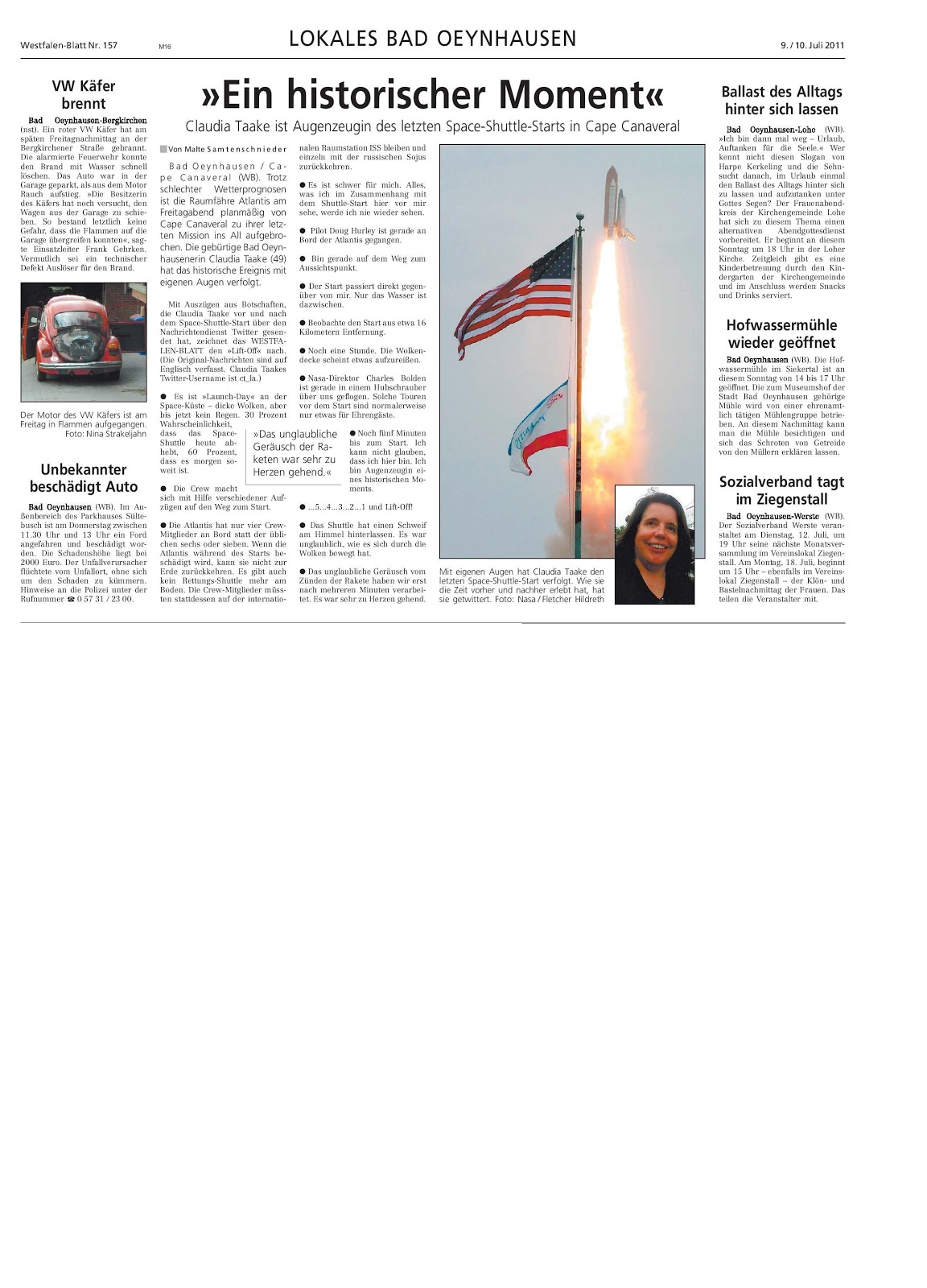
My Coverage of STS-135 in Westfalen-Blatt (Bad Oeynhausen, Germany)


Being a spacetweep is all about outreach and inspiration via social media. When a German twitter follower of mine learned that I was traveling to Florida to witness the last Space Shuttle launch on July 8, 2011, he pointed out that many local Germans don't even know or care about the end of the Space Shuttle program. I decided to contact both papers in my hometown of Bad Oeynhausen to see if they wanted to interview me while experiencing STS-135 in person. Did they ever! I was asked for and promised exclusive coverage to the first paper that responded, the Westfalen-Blatt. I figured if I can reach, inspire or educate just one person in Germany, it would be worth the effort. I anticipated publication with some degree of trepidation and was pleasantly surprised. The journalist who interviewed me, Malte Samtenschnieder, did a great job. I was especially happy to see her translation of my STS-135 launch tweet stream in my hometown newspaper.

If you read German, you can see for yourself (scroll down to PDFs). If you don't, here are the Cliff Notes:

The first PDF page is the transcript of the interview with me a few days before my trip to the Space Coast. It was published pre-launch on July 8, 2011 and the picture on the right is actually of the last launch of Discovery on February 24, 2011 (STS-133). The interview mainly covers how I became a space geek and how NASA's social media activism, especially on twitter, has created a growing global community of spacetweeps and citizen scientists that will help launch the coming era of space tourism, private space exploration and permanent human colonies in low-earth orbit, the Moon, Mars and other solar system destinations. 

I also give a shout-out to Sonja Rohde, who is slated to become the first German space tourist and the first German woman in space. She is from my home state of Nordrhein-Westfalen. There are also sidebars with my biographical info and about the STS-135 mission profile and crew members. The interview was featured on the Westfalen-Blatt's front page.

The second PDF page is a second article by the same journalist published post-launch in the Westfalen-Blatt's weekend edition of July 9/10, 2011. It is a translation into German of my live tweets on launch day. While historic space events tend to cause cell phone and network outages due to overload, I got lucky. All my launch-related tweets got through, without delay. I even composed my launch tweet "...5 ...4 ...3 ...2 ...1 and Lift-Off!" ahead of time, with my finger on the "Send" button and my eyes on the launch pad. (Have I noted recently that smart phones are cooler than tricorders?). 

If you don't read German but follow my twitter feed - or space events, for that matter - you don't need a translation of the second article. I should add that the translation is very good and accurately captures what I was trying to convey. Except for one quibble that only matters to those who read both German and English. I tweeted about how shuttle launch sound waves are something you feel *viscerally*, in addition to seeing and hearing them - a feeling you just don't experience unless you're physically close to a couple million tons of propellants being ignited. The translation of "visceral" ended up as "zu Herzen gehend" (heartfelt), which is an ok translation, but not really what I said in English. It's a tough one, though, so I'm giving the translator a pass :)

Most of all, these articles are symbolic of what space activism and outreach is all about for me: It is about communication, passion, creativity and hope, the transcendence of national borders and cultural differences, and a focus on building a better future for all humankind.


Click here to read about my launch day experience in English.


Sunday, September 23, 2012

Welcome to Los Angeles, Endeavour!


Space Shuttle Endeavour arrived safely and to a huge welcome at Los Angeles International Airport on Friday, September 21, 2012.

Since it's easy to get caught up in the excitement of seeing a space shuttle soar overhead on top of a modified 747 (aka SCA = shuttle carrier aircraft) let's take a look at a rare photograph first. Below is Endeavour in her full splendor docked to the completed International Space Station during her last mission to space. Italian Astronaut Paulo Nespoli snapped this picture on May 23, 2011 from a Soyuz capsule. While there are a number of photos showing parts of shuttles photographed from inside the ISS, this is the only picture showing all of Endeavour docked to the completed ISS. This picture shows her doing what she was made for: Spaceflight. Building and servicing the International Space Station. An amazing machine that gave us the ability to construct a human outpost in orbit. Endeavour may be ready for retirement now and I can't wait to visit her at her new home at the California Science Center. I'm sure she will be breathtaking. 


But to me she was never more magnificent than doing what she did best - In Space.


Photo credit: Paulo Nespoli / NASA


Around 9 a.m. on Sept. 21, I started making my way to LAX a few miles away. I took the bus and train to avoid the predicted traffic chaos and shortage of parking at the location I had in mind: The East Side of Aviation Blvd, at the end of LAX's south runway. If you know the area, this stretch of road is located north of the Proud Bird restaurant. The runway starts on the other side of the street. It's a great spot for watching incoming planes fly low before touchdown. 

I arrived at the location at 10:30 a.m, as planned, for a shuttle landing time of 11 a.m., just as I learned that landing time had been postponed to 12:45 p.m. Aviation Blvd. is not one of those quaint, picturesque L.A. streets. It's a major four-lane airport access road and the ambiance is razor wire fence-industrial. The "sidewalk" is a narrow strip of gravel.  (Note: If you ever find yourself stranded on a narrow strip of gravel for a long wait, do so with a Southwest flight attendant who has a carry-on. They have everything you need in that bag for hot, dusty, historic space events!)


When I arrived, the crowd was still relatively thin. I settled in for a 2+ hour wait. Twitter dropped in and out of being accessible during that time so my #spottheshuttle tweets from the location are a bit... spotty. 

As I have found to be the case at all space events, nothing is easier than striking up a conversation with strangers. I met two flight attendants from Southwest Air, one who had come from Minneapolis, the other Las Vegas. I met an engineer who had worked on Endeavour's SSMEs. A mother who had brought her kid to see the shuttle; they had been waiting since 6 a.m. Two film students with professional equipment who planned to get footage of the landing and use it in their film project this semester, and many more. As a bonus, I got a ferocious sunburn despite SPF50. No matter.

By noon, the crowd had grown considerably and was now clustered along Aviation Blvd. in both directions as far as anyone could see. The cops amused us trying to contain everybody on the gravel strip, keeping them out of the bike path and street. This was a doomed effort. The bike path was ours. During the shuttle's final landing approach, the cops caved in, stopped traffic and let us take the street. That is when the long, dusty, brutally hot wait paid off. This is what we saw - no zoom, no filters, a glorious moment:


Photo credit: Tanya Ehret


The aircraft in the upper right is an F-19 fighter aircraft, one of two that accompany the shuttle carrier aircraft (SCA), a converted 747, flying space shuttles across the country. While the shuttle program was active, NASA maintained two SCAs to return shuttles from California. Shuttle landings were diverted to land at Edwards Air Force Base in California on a number of occasions.


Video credit: Tanya Ehret

 
The landing approach was Endeavour's third pass above us. We first glimpsed the plane carrying Endeavour as a speck in the northwest, from the direction of Santa Barbara, heading inland over Santa Monica, beginning its flyby of L.A. landmarks, including Griffith Observatory and Jet Propulsion Laboratory. The SCA then headed south, where it flew over Disneyland, Boeing and the U.S.S. Iowa. It then returned to LAX and gave us two approaches: The first one much higher than the above pic; even though it looked like it might land. At the last moment, the 747 pulled up and completed one last long loop to the southeast toward its final landing approach.    Welcome to Los Angeles, Endeavour! We are proud to have you. I will see you again during the parade to the CA Science Center on October 12. Below is a collection of some of my favorite photos.  


Endeavour began her journey to Southern California with flyovers of Sacramento and San Francisco 


Endeavour over Candlestick Park in San Francisco.


The two photos above were taken by a photographer for the L.A. Times from a skyscraper rooftop in nearby downtown Los Angeles


 A sight that was never before seen over downtown Los Angeles - 
and never will be again


 Endeavour soars over NASA's Jet Propulsion Laboratory in Pasadena 


 Touchdown at LAX


 You don't see this every day: Angelenos stop and get out of their cars along a busy airport access road to get a better look at History in the Making. 


By Saturday afternoon, Endeavour had been de-mated from the SCA. This marks the first time Endevour was seen nose-to-nose with a NASA shuttle carrier aircraft


Saturday, May 19, 2012

T - 90 Minutes And Counting ~


As I write this, it is exactly T - 90 minutes from the scheduled launch time for Space X's demonstration mission to the International Space Station. A Falcon 9 rocket with its Dragon capsule payload is slated to lift off from Pad 40 at Kennedy Space Center at 1:55 a.m.

Space X is poised at the brink of making history. A successful mission means Space X will become the first private entity on the planet to not only achieve orbit, but to dock with the ISS. The symbolism of this feat cannot be overstated at a time when NASA is reeling from funding cuts and the iconic Space Shuttle will never fly again. 

More importantly, Space X has ambitious plans that go far beyond the symbolic. The Dragon capsule can function as a reusable spacecraft to carry astronauts to the ISS and beyond. Space X founder Elon Musk envisions manned missions to Mars within the next 10 years and a burgeoning space tourism industry that will offer round trip rocket rides to space stations, habitats and other future destinations in low Earth orbit and beyond. 

Within the next 20 years, space travel, space ships and suborbitals will become as commonplace as air travel and aircraft. We have finally reached the dawn of an era that will make space accessible to those who want to experience it, on a large scale.  90 minutes from now, Space X is set to pave the way!

Go Space X!

Go Falcon!

Go Dragon!


Monday, March 5, 2012

When Astronauts tweet: @astro_andre's video #fromspace


After my last blog entry last night, I was delighted this morning to see ESA astronaut @astro_andre tweet this time lapse video of Western Europe at night from the International Space Station. Can you identify the major population centers? Gotta be quick - we're traveling at 5 miles per second! Probably a lot faster, since it's a time lapse.


@astro_andre is André Kuipers, a Dutch astronaut currently on orbit. For more about André Kuiper's life on the ISS, follow his blog here (in English)

Sunday, March 4, 2012

When Astronauts tweet: @astro_ron's Pictures #fromspace or Why Geography is Fun

Astronaut Ron Garan @astro_ron is one of my favorite tweeters - That means he ranks way up there in the Top 5 tweeters I like to read when I look at my phone in the morning. 


Last year, Ron spent a few months on the International Space Station. In the process, he took hundreds of photographs #fromspace (a twitter search for this hashtag and #fragileoasis will amaze you). He often published his pics on twitter, asking "Where on Earth is this?", leaving his followers to test their geography skills. If you think you know your geography, I invite you to test your geographic mettle by perusing Ron's photos #fromspace. No more neat lines and labeled countries. No more predictable North is up - West is left orientation. Just snapshots of our Planet, rotating in its Inimitable Splendor.

With most of Ron's photos, I really wasn't sure what part of Earth I was looking at. I considered myself lucky if I could identify a coastline or mountain range. I aced geography in school. As an avid follower of @astro_ron, I correctly identified immediately just one geographic feature - a day time picture of Lake Victoria. I looked for that picture for this article, but no luck. If anyone has the URL to the Lake Victoria pic, please send it along.

Here is another one of Ron's pictures that I recognized immediately:


Here is another night time picture of several metropolitan cities that a lot of people on this Earth will swear up and down they can pick out on a Map. They'll look at this Actual Photograph and won't be able to locate those cities without a good amount of doubt and guesswork.
What fun!