As I get ready for my first NASA Social as a participant
selected for social media accreditation at NASA Dryden on January 25, it's the perfect time to look back on the history of these unparalleled NASA-sponsored outreach
events.
The first gathering of some of @NASA’s twitter followers
took place almost four years ago on January 21, 2009 at NASA’s Jet Propulsion
Laboratory in Pasadena , CA. It was the brain child of Veronica McGregor
(@VeronicaMcG) and her colleagues at JPL, who saw an opportunity to foster more
direct engagement with twitter users around the world. The gathering was
initially called a NASA Tweetup. 150 of
NASA’s twitter followers were invited to spend an evening touring JPL facilities, interacting with scientists, learning about space exploration and getting rare
behind-the-scenes access to NASA projects. A huge success, the first Tweetup
was soon followed by others, including the last seven space shuttle launches
from Kennedy Space Center. Participants
at those Tweetups witnessed a shuttle launch from three miles away – as close as
anyone can safely get to a launch.
NASA Tweetups changed to NASA Socials in 2012. While I will
always have a special affinity for the #NASAtweetup hash tag, I do admit that #NASASocial
is more efficient. This is twitter after all - every character counts! It is also
more accessible to those unfamiliar with these NASA gatherings. If you are
reading this, you have probably tried to explain a “NASA Tweetup” to someone who
has never been on twitter and has only a vague idea of what NASA actually does.
It’s a challenge, requiring explanation of what a tweet is, how social media
connect people with similar interests, how online communities lead to real
world connections, and related matters. That’s before you even get to NASA’s
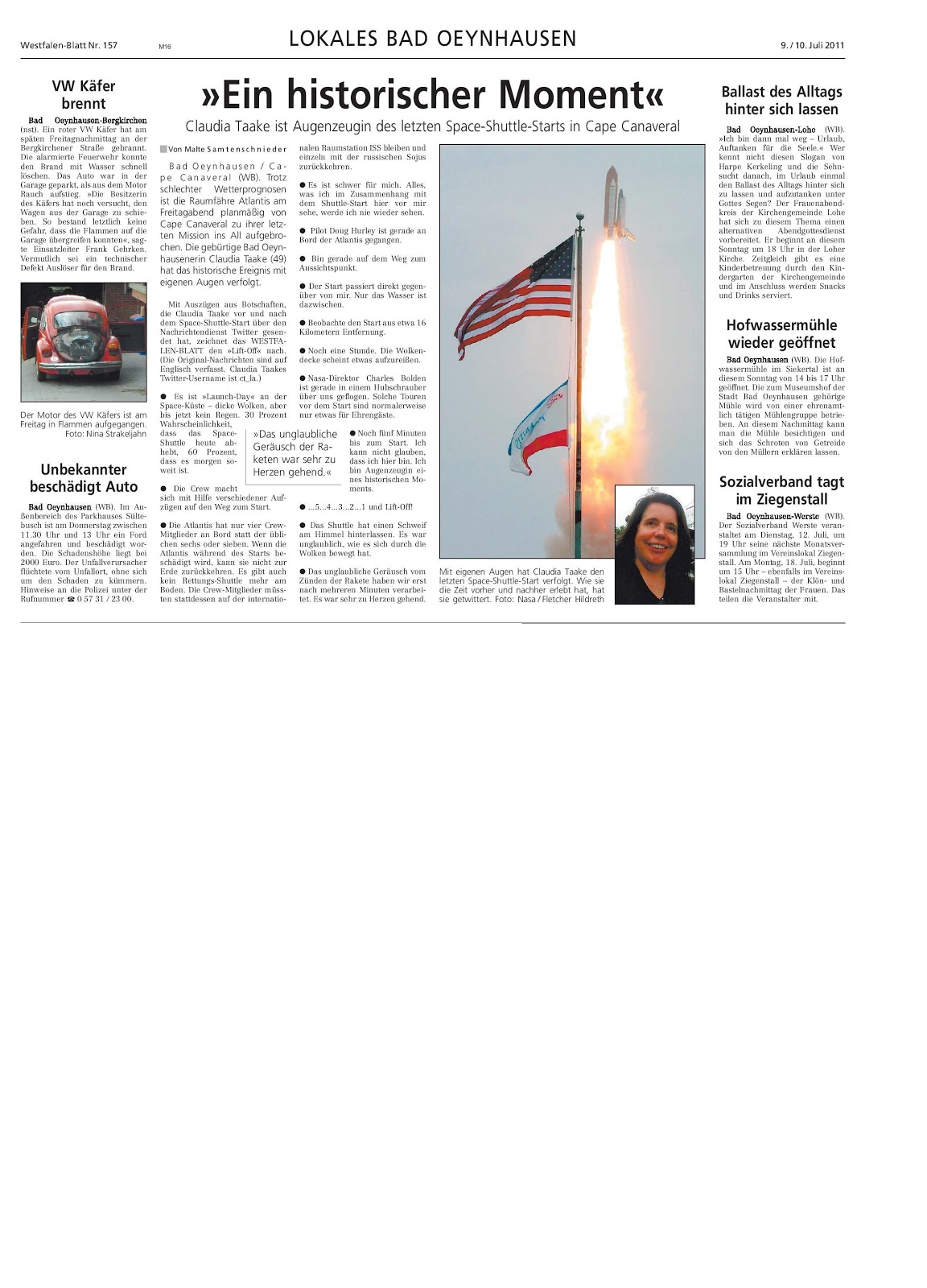
role in it. Now try doing it in German, like I did for an interview with a
German newspaper in 2011: http://www.lotsinspace.blogspot.com/2012/12/what-do-sts-133-sts-135-twitter-and-bad.html
So NASA Tweetups have happily evolved into NASA Socials, and
the momentum shows no signs of slowing down. I wonder what the next four years
will bring?
I joined twitter in 2008, mostly as a way to connect with
other ferret lovers. Now, a little over
four years and almost 12,000 tweets later, I continue to use twitter and other
social media primarily to stay in touch with and exchange space-related info and
news with other #spacetweeps. This hash tag has been adopted by those of us on
twitter – many, if not most of us alumni of NASA Tweetups and NASA Socials –
who are hopelessly in love with space and all the potential that robotic and
manned human spaceflight holds for our future.
I discovered NASA Tweetups in the summer of 2010 – on twitter,
of course. I have been following @NASA since I started tweeting and noticed the
NASA Tweetup announcement for the last launch of Space Shuttle Discovery
STS-133, planned for early November 2010. I was amazed at the opportunity being
offered: A chance to see a shuttle launch from three miles away and all I
needed was a twitter account that followed NASA. I had that! I applied to the Tweetup,
still somewhat incredulous at this marvelous opportunity. I told one other
person, my friend Tallulah (@tallulah_kidd), who also applied. NASA received
3,000 applications for the STS-133 Tweetup, and selected 50 to attend. Tallulah
was chosen, I was not. There is much
speculation among spacetweeps how NASA
selects tweetup/social attendees. There is a general agreement that the
selection process is largely random.
I was thrilled that Tallulah got to go, even more so when I
discovered that I could be part of the Tweetup activities – at NASA and after
hours – by watching the live streams set up by Tweetup attendees, including
Joel Glick’s (@joelglick) now infamous “hat cam” he wore inside Kennedy Space
Center. During one such live stream, I
heard @craftlass perform her now famous song “Bake Sale for NASA”. If you have never
listened to her passionate music advocating human space exploration, you can do
so here: craftlass.com
Hearing @craftlass’s music, seeing Tallulah in the midst of
dozens of people - most of whom had been strangers to each other the day before
- celebrating together, getting excited about space, science and seeing a
shuttle launch, all of that was transformational for me. It gave me an
unprecedented outlet for my lifelong passion for space and the establishment of
permanent human outposts off our planet. This blog is one of the results.
Now, a little over two years later, my spacetweep network numbers
are in the hundreds and I have met dozens of them in person. There is something
about us space geeks that lets us get together as total strangers and leave a
short time later with lasting friendships. Maybe it’s the revenge of the geeks.
Many of us remember childhoods when geekiness wasn’t exactly cool or popular ~
And just look at all the adventures we are having now!
I attended my first NASA Tweetup in June 2011 at Jet
Propulsion Laboratory. The highlight of the day was seeing Mars rover Curiosity
from about 15 feet away: The visitor’s gallery in JPL’s clean room, where
Curiosity was being prepared for shipment to Kennedy Space Center and her
launch later that year. A particular
treat was signing a guest book so that the signatures could be digitized and
stored on Curiosity. Read more about my
JPL Tweetup adventure here: http://www.lotsinspace.blogspot.com/2012/02/curiosity-meeting-mars-science.html
I did not get selected to attend the NASA Tweetup for the
last space shuttle launch (Atlantis STS-135, July 2011) but joined the Space Park View
Tweetup in Titusville, FL and traveled to Florida anyway. There, I shared a house with other
spacetweeps and was rewarded with an unforgettable launch experience. Read more
about it here: http://www.lotsinspace.blogspot.com/2012/04/space-shuttle-atlantis-sts-135-final.html
Since then, I have been waitlisted, but not accepted, four
times in a row for NASA launch Tweetups and Socials, starting with Curiosity's launch in
November 2011 to the TDRS-K tracking satellite launch later this month. I was
starting to think someone at NASA got a kick out of teasing me.
Then something awesome happened, like it often does when
NASA is involved: I was selected to receive social media accreditation for the
next NASA Social at Dryden, Airborne Earth Sciences (#NASA_Airborne) on January
25, 2013. This is a different type of
NASA Social, where selection is not random and participants are chosen based on
their social media posting history.
According to NASA:
What are NASA Social media credentials?
Social media credentials give users a chance to apply for the same access as journalists in an effort to align the access and experience of social media representatives with those of traditional media. People, who actively collect, report, analyze and disseminate news on social networking platforms are encouraged to apply for media credentials. Selection is not random. All social media accreditation applications will be considered on a case-by-case basis. Those chosen must prove through the registration process they meet specific engagement criteria.
Social media credentials give users a chance to apply for the same access as journalists in an effort to align the access and experience of social media representatives with those of traditional media. People, who actively collect, report, analyze and disseminate news on social networking platforms are encouraged to apply for media credentials. Selection is not random. All social media accreditation applications will be considered on a case-by-case basis. Those chosen must prove through the registration process they meet specific engagement criteria.
Do I need to have a social media account to register?
Yes. This event is designed for people who:
Yes. This event is designed for people who:
- Actively use multiple social networking platforms and tools to disseminate information to a unique audience.
- Regularly produce new content that features multimedia elements.
- Have the potential to reach a large number of people using digital platforms.
- Reach a unique audience, separate and distinctive from traditional news media.
- Must have an established history of posting content on social media platforms.
- Have previous postings that are highly visible, respected and widely recognized.
I am honored that I was chosen as
a social media representative for the Airborne Earth Sciences Social at NASA Dryden. I
promise to bring exciting and up-to-the-minute coverage to my readers and followers!
There is a wiki page with details
about all past and upcoming NASA Tweetups and Socials. Please note that participant
lists may not be complete: http://en.wikipedia.org/wiki/NASA_Tweetup
You can also join the wiki community here: http://www.nasatweet.com/
You can also join the wiki community here: http://www.nasatweet.com/