Being a spacetweep is all about outreach and inspiration via social media. When a German twitter follower of mine learned that I was traveling to Florida to witness the last Space Shuttle launch on July 8, 2011, he pointed out that many local Germans don't even know or care about the end of the Space Shuttle program. I decided to contact both papers in my hometown of Bad Oeynhausen to see if they wanted to interview me while experiencing STS-135 in person. Did they ever! I was asked for and promised exclusive coverage to the first paper that responded, the Westfalen-Blatt. I figured if I can reach, inspire or educate just one person in Germany, it would be worth the effort. I anticipated publication with some degree of trepidation and was pleasantly surprised. The journalist who interviewed me, Malte Samtenschnieder, did a great job. I was especially happy to see her translation of my STS-135 launch tweet stream in my hometown newspaper.
If you read German, you can see for yourself (scroll down to PDFs). If you don't, here are the Cliff Notes:
The first PDF page is the transcript of the interview with me a few days before my trip to the Space Coast. It was published pre-launch on July 8, 2011 and the picture on the right is actually of the last launch of Discovery on February 24, 2011 (STS-133). The interview mainly covers how I became a space geek and how NASA's social media activism, especially on twitter, has created a growing global community of spacetweeps and citizen scientists that will help launch the coming era of space tourism, private space exploration and permanent human colonies in low-earth orbit, the Moon, Mars and other solar system destinations.
I also give a shout-out to Sonja Rohde, who is slated to become the first German space tourist and the first German woman in space. She is from my home state of Nordrhein-Westfalen. There are also sidebars with my biographical info and about the STS-135 mission profile and crew members. The interview was featured on the Westfalen-Blatt's front page.
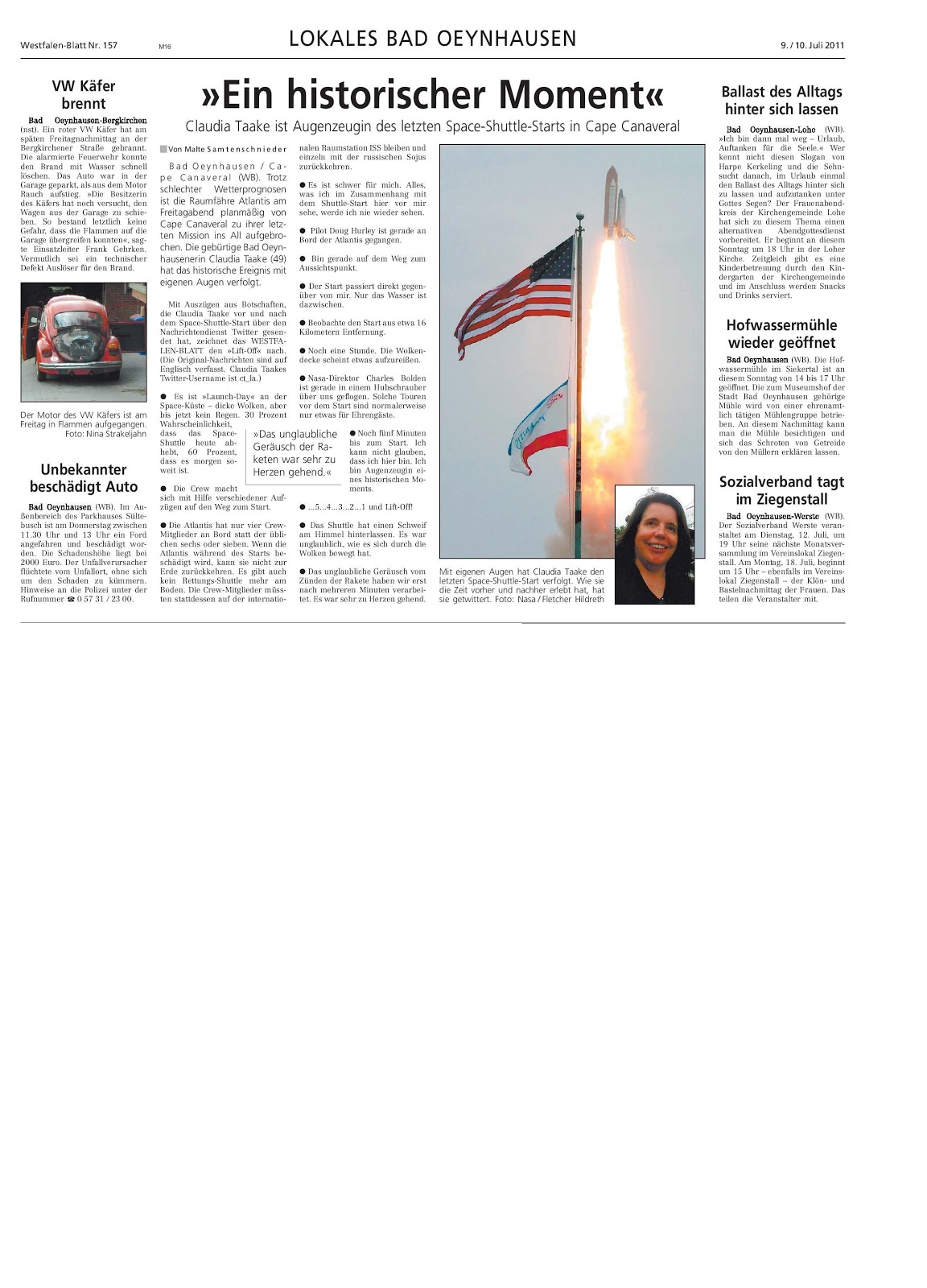
The second PDF page is a second article by the same journalist published post-launch in the Westfalen-Blatt's weekend edition of July 9/10, 2011. It is a translation into German of my live tweets on launch day. While historic space events tend to cause cell phone and network outages due to overload, I got lucky. All my launch-related tweets got through, without delay. I even composed my launch tweet "...5 ...4 ...3 ...2 ...1 and Lift-Off!" ahead of time, with my finger on the "Send" button and my eyes on the launch pad. (Have I noted recently that smart phones are cooler than tricorders?).
If you don't read German but follow my twitter feed - or space events, for that matter - you don't need a translation of the second article. I should add that the translation is very good and accurately captures what I was trying to convey. Except for one quibble that only matters to those who read both German and English. I tweeted about how shuttle launch sound waves are something you feel *viscerally*, in addition to seeing and hearing them - a feeling you just don't experience unless you're physically close to a couple million tons of propellants being ignited. The translation of "visceral" ended up as "zu Herzen gehend" (heartfelt), which is an ok translation, but not really what I said in English. It's a tough one, though, so I'm giving the translator a pass :)
Most of all, these articles are symbolic of what space activism and outreach is all about for me: It is about communication, passion, creativity and hope, the transcendence of national borders and cultural differences, and a focus on building a better future for all humankind.