Wednesday, December 26, 2012

My Coverage of STS-135 in Westfalen-Blatt (Bad Oeynhausen, Germany)


Being a spacetweep is all about outreach and inspiration via social media. When a German twitter follower of mine learned that I was traveling to Florida to witness the last Space Shuttle launch on July 8, 2011, he pointed out that many local Germans don't even know or care about the end of the Space Shuttle program. I decided to contact both papers in my hometown of Bad Oeynhausen to see if they wanted to interview me while experiencing STS-135 in person. Did they ever! I was asked for and promised exclusive coverage to the first paper that responded, the Westfalen-Blatt. I figured if I can reach, inspire or educate just one person in Germany, it would be worth the effort. I anticipated publication with some degree of trepidation and was pleasantly surprised. The journalist who interviewed me, Malte Samtenschnieder, did a great job. I was especially happy to see her translation of my STS-135 launch tweet stream in my hometown newspaper.

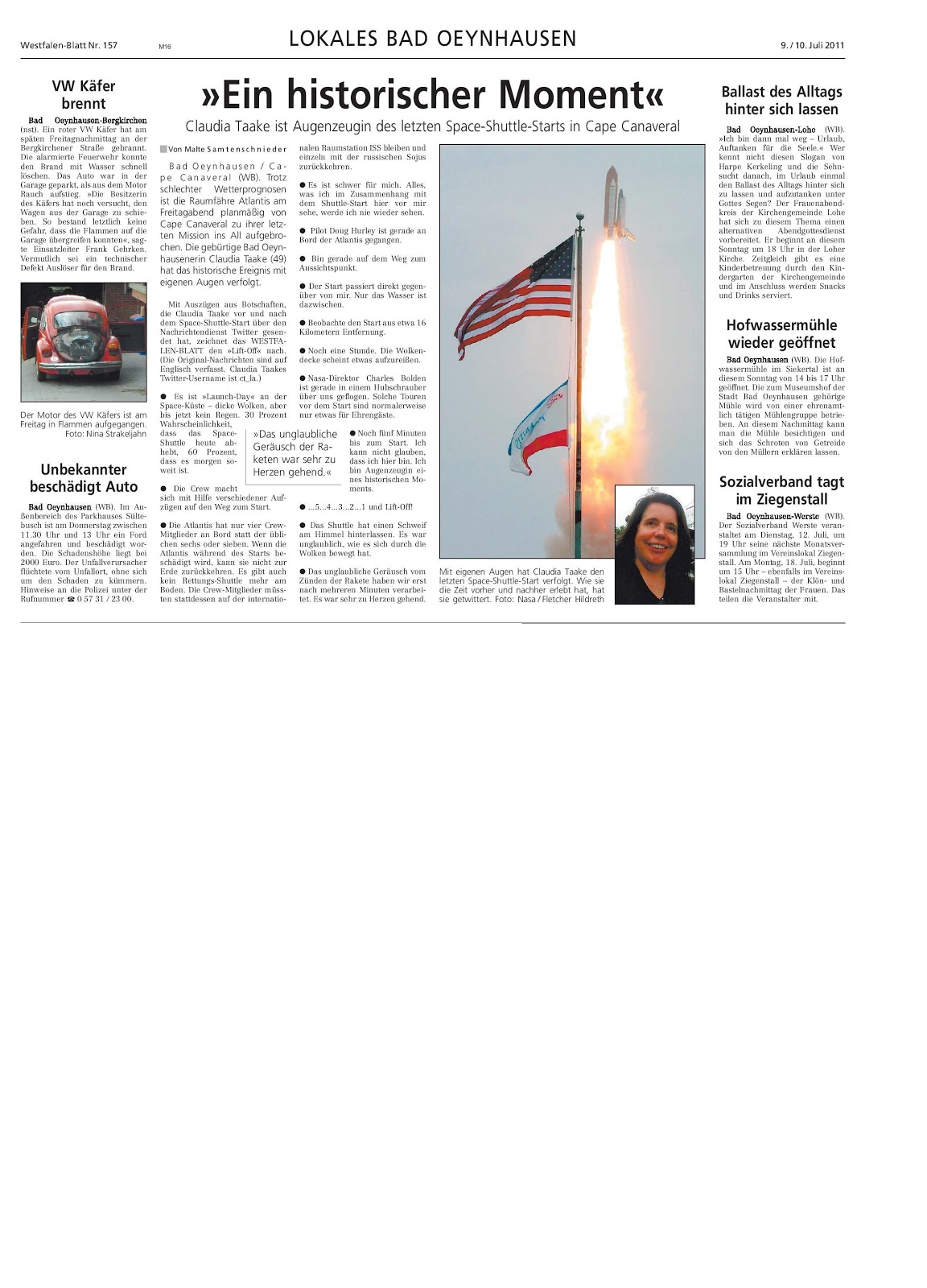
If you read German, you can see for yourself (scroll down to PDFs). If you don't, here are the Cliff Notes:

The first PDF page is the transcript of the interview with me a few days before my trip to the Space Coast. It was published pre-launch on July 8, 2011 and the picture on the right is actually of the last launch of Discovery on February 24, 2011 (STS-133). The interview mainly covers how I became a space geek and how NASA's social media activism, especially on twitter, has created a growing global community of spacetweeps and citizen scientists that will help launch the coming era of space tourism, private space exploration and permanent human colonies in low-earth orbit, the Moon, Mars and other solar system destinations. 

I also give a shout-out to Sonja Rohde, who is slated to become the first German space tourist and the first German woman in space. She is from my home state of Nordrhein-Westfalen. There are also sidebars with my biographical info and about the STS-135 mission profile and crew members. The interview was featured on the Westfalen-Blatt's front page.

The second PDF page is a second article by the same journalist published post-launch in the Westfalen-Blatt's weekend edition of July 9/10, 2011. It is a translation into German of my live tweets on launch day. While historic space events tend to cause cell phone and network outages due to overload, I got lucky. All my launch-related tweets got through, without delay. I even composed my launch tweet "...5 ...4 ...3 ...2 ...1 and Lift-Off!" ahead of time, with my finger on the "Send" button and my eyes on the launch pad. (Have I noted recently that smart phones are cooler than tricorders?). 

If you don't read German but follow my twitter feed - or space events, for that matter - you don't need a translation of the second article. I should add that the translation is very good and accurately captures what I was trying to convey. Except for one quibble that only matters to those who read both German and English. I tweeted about how shuttle launch sound waves are something you feel *viscerally*, in addition to seeing and hearing them - a feeling you just don't experience unless you're physically close to a couple million tons of propellants being ignited. The translation of "visceral" ended up as "zu Herzen gehend" (heartfelt), which is an ok translation, but not really what I said in English. It's a tough one, though, so I'm giving the translator a pass :)

Most of all, these articles are symbolic of what space activism and outreach is all about for me: It is about communication, passion, creativity and hope, the transcendence of national borders and cultural differences, and a focus on building a better future for all humankind.

Click here to read about my launch day experience in English.


Friday, November 30, 2012

Tragedy Remembered: January 28, 1986


On that fateful winter day in 1986, I was a newly minted grad student at UCLA in the then-fledgling area of cognitive science, where I was able to assemble my own interdisciplinary course of study and research. I chose computational psycholinguistics, which meant that my goal was to invent the Universal Translator (as seen on Star Trek) by the time I was 25 and single-handedly revolutionize global and cross-cultural communication.  The reality of technological limits put a damper on these aspirations soon enough. But in the winter of 1986, I felt I was in the right place at the right time to change the world.
In addition, just a couple of weeks prior, I had met a human factors engineer who was working on improving the space shuttle crew compartment and on designing living quarters for the planned space station, which was named “Freedom” at the time, a very ambitious project that was later scaled back into what is now the ISS. She soon hired me as a consultant, once she realized that I have a background (more by accident than by choice) in quantification of human movement across three dimensions. We spent many hours together in front of a TV set and VHS VCR, watching NASA footage of astronauts moving about various shuttle compartments in space, followed by many more hours of devising ways to measure and quantify their movements. Most of the footage was from Challenger missions.
It was during these hours that I lived through one of the most intellectually embarrassing moments of my life. While we were discussing the difficulties that moving about in microgravity added to obtaining consistent measurements, I suddenly had a seemingly brilliant idea: “Hey! Why don’t we suggest to NASA to film astronauts in microgravity during an upcoming mission – have them do some basic movements that can be used as baselines. Put some lead boots on them so they’ll always have their feet on the floor!”  I looked at her expectantly and could tell she was trying not to laugh. :::::dramatic pause::::: …. and…. the light went on in my brain (about 30 seconds too late, thanks a lot, brain). I just wanted to disappear. Thankfully, she laughed and said “Don’t worry – that happens to everybody!”
This collaboration ended with a job offer to work full time in human factors psychology to design living quarters on space station Freedom.
So the question “Grad school as I had planned or a job in the space industry that just happened to fall into my lap?” was very much on my mind as I walked across the UCLA campus to the research methods lab class I was teaching early that morning on January 28, 1986. I knew there was a launch that morning, but like so many others, I had already started taking them for granted after 5 years and didn’t give it much thought. I walked through the student union where everybody appeared to be clustered around two TV sets. Deep in my own thoughts, I ignored them and figured it had something to do with a football game, the only other occasion during which I had seen students glued to the TVs like that.
When I walked into my classroom I could tell instantly something was wrong. I attempted to make a joke about “all the long faces”. “You don’t know?” one of the students asked. “Know what?” “The space shuttle! It exploded! They’re all dead!” (I realize Challenger did not actually explode and there had not been any official announcement on the fate of the crew). The news hit me like a physical punch. I took two steps back against the wall and had to consciously keep from sliding to the floor. I don’t remember much after that. I don’t remember if I taught the class, cancelled it, or anything else about that day. I do remember very vividly that the wait for answers about what had happened was frustrating and excruciating. I never looked at a space shuttle the same way again. And I never once took them or their voyages for granted again.
I did stay in grad school. The job offer was still on the table, but I decided against it. A year later, the human factors program for space station Freedom was cancelled and my friend was transferred to a department that had her working on improving the ergonomics of combat plane cockpits. After all, this was the era of Star Wars. No, not George Lucas' Star Wars. Rather, the giant defense industry boon(doggle) that was Ronald Reagan's Star Wars.
I don’t usually believe in chasing “What ifs” but in this case it’s hard not to speculate.
I keep Challenger’s last mission patch in a special place – as a reminder not of what could have been, but as inspiration for all that which we will yet achieve in space.

Challenger's last mission patch on the left

A heat tile  from Challenger's wreckage at the Santa Maria Museum of Flight in Santa Maria, CA

Read more about the Santa Maria Museum of Flight and the history of the space shuttle at Vandenberg AFB: