Showing posts with label landing. Show all posts

Wednesday, August 31, 2016

SpaceX JCSAT-16 Mission: A Beautiful Night Launch...And Landing!


On Sunday, August 14, SpaceX launched a Japanese satellite into orbit, the JSAT 16, as part of a beautiful night launch, topped off by a perfect landing of the rocket's first stage on SpaceX's ocean-going barge "Just Read The Instructions".


Image credit: SpaceX
Falcon 9 on the pad at Cape Canaveral after sunset on launch night


Image credit: SpaceX
JCSAT 16 mission patch


This was the second time that a JSAT Corporation satellite traveled to orbit atop a SpaceX rocket.The first was JCSAT 14. The JCSAT network is designed to support and expand communication services across Asia. Prior to choosing SpaceX as a launch provider, JSAT Corporation's satellites usually launched on Europe's Ariane rocket from Kourou, French Guinea.


Image credit: SpaceX
Liftoff of Falcon 9 with JCSAT 16 payload at 1:26 am EDT, right at the start of a 2-hour launch window


Source: SpaceX
Graphic illustrating Falcon 9 launch and landing arc


JCSAT 16 was launched to geostationary transfer orbit (GTO), an orbit much further out than a low Earth orbit (LEO) destination such as the International Space Station. Since Falcon 9 had to travel further, it had little fuel left prior to re-entry, and thus fewer options to maneuver using controlled burns to reach the landing destination. A Falcon 9 returning from geostationary transfer orbit lands harder than one returning from a mission to the ISS. After a previous mission to GTO, Falcon 9's recovered first stage listed visibly to one side on the barge as it returned to port, an indication that at least some of the rocket's struts and dampers had been pushed to the limits of their capability during touchdown.


Below is SpaceX's full webcast for the launch and landing. As always, the entire video is worth watching, but if you want to skip to the good parts, the legend on the bottom tells you when the launch, landing and payload delivery events occur.


Video source: SpaceX
Live webcast from SpaceX HQ in Hawthorne, CA, detailing all the stages of the mission.


Friday, July 22, 2016

Last Monday's Perfect SpaceX CRS-9 Launch And Landing In Pictures


Last Monday's commercial resupply mission to the International Space Station was a perfect night launch from Cape Canaveral, topped off by a successful return to launch site, which means SpaceX landed a Falcon 9 first stage back at the launch site, while the Dragon capsule it sent to orbit continued on to dock with the ISS. This landing marks the second time SpaceX has returned a rocket intact to a launch site on land. Rocketry doesn't get more picture perfect than this:
 

Image credit: SpaceX

Falcon 9 and its ISS-bound Dragon payload launch into the night sky in Florida...


Image credit: SpaceX


Image credit: SpaceX

...and then Falcon 9 returns to its launch site a few minutes after lift-off.
This picture shows the landing burn just before touchdown.


Image credit: SpaceX

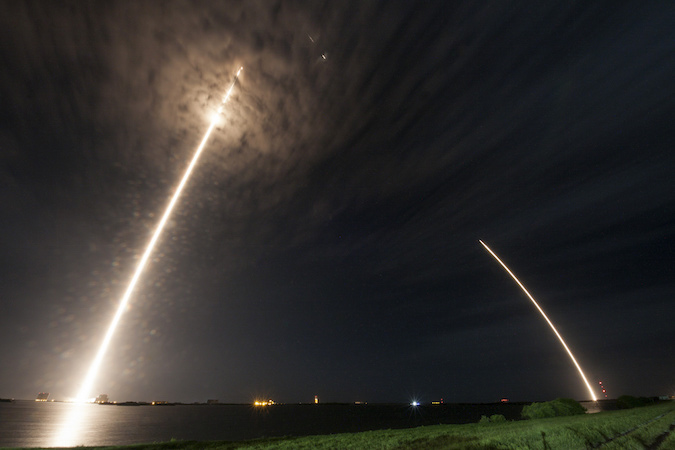
The above long exposure image shows a familiar night sight on the Cape: a launch into orbit on the left. Not so familiar are the landing burn on the right and the re-entry burn visible at the center top of the image. Falcon 9 performs three burns to land: the boostback burn right after payload separation, which reorients the rocket in orbit in preparation for landing. This is followed by the re-entry burn. Spent rockets used to burn up in the atmosphere at this point. SpaceX's technological advances guide them back to Earth for re-use. The third and final burn occurs just before landing.


Image credit: SpaceX

Long exposure image of the launch and landing burn:
Falcon 9 returns to land next to the launch location.


Image credit: SpaceX

Launch, re-entry and landing burns with SpaceX signage at Cape Canaveral


Image Credit: SpaceX

SpaceX marks the spot: Falcon 9 just after it returned to the launch pad location


Image Credit: SpaceX

Dragon cargo capsule CRS-9, solar wings extended, approaches the ISS


After Dragon docked to the International Space Station on Thursday, NASA shared the following two tweets:


Monday, May 9, 2016

SpaceX Just Landed A Second Rocket On A Drone Ship - At Night!


Friday, May 6, 2016 was National Space Day, a great annual day of celebration and acknowledgment of our human future in space. My Twitter feed was abuzz with info from space companies, including NASA, hosting special events and exhibits for the day. This inspired my following tweet, and brings us to the topic of this blog post:


Yes, SpaceX landed another spent rocket stage on an ocean-going barge, the "Of Course I Still Love You", during high waves and wind, with the rocket coming in faster and hotter than it did last month. This time, SpaceX was tasked with delivering a Japanese satellite, the JCsat-14, into high geo-stationary transfer orbit at about 25,000 mi (36,000 km) above Earth's surface. Compare this to last month's successful launch and landing mission, when Falcon traveled into low-earth orbit (LEO) "only", ca. 250 mi (400 km) above our planet, to re-supply the International Space Station. Consequently, last Friday, Falcon was traveling many thousands kilometers faster on ascent than it did last month and also had less fuel available for those critical pre-landing burns upon its return. And yet, Falcon 9 landed perfectly, under harsh conditions, standing proud and tall on its landing barge, still breathing fire. And you know what? I'm starting to feel less and less nostalgic about the Space Shuttle.


Image credit: SpaceX
Falcon 9 with its JCsat-14 satellite payload on the pad at Cape Canaveral, awaiting launch. The rocket stands 229 ft (70m) tall.


Image credit: SpaceX
Mission patch for the JCsat-14 mission


Image credit: SpaceX
LIFTOFF of Falcon 9 with its JCsat-14 payload!


Image credit: SpaceX
Trajectory of Falcon 9 and its payload en route to 36,000 km above Earth

While last month's barge landing happened during the day time and was filmed by nearby quad copters from the air, no such footage exists for last week's night landing. The only transmitting cameras were mounted on the barge itself. This led to temporary "white out" conditions as the brightness of the landing burn briefly overloaded the cameras. Those were nail-biting seconds. Did Falcon land? Did it break apart? Did it fall into the ocean? It wasn't until the brightness had receded that the barge's camera revealed Falcon 9's landing legs intact, and with that, another upright, beautiful landing of historic significance. 

Congratulations to Elon Musk and the entire team at SpaceX!


Image credit: SpaceX
View of landed Falcon 9 upper stage - still breathing fire - on the drone ship


Image credit: SpaceX
Recovered Falcon 9 on SpaceX's drone ship the next morning in all its - albeit a bit scorched - glory. (Let's see you travel 36,000 km out and then back into the atmosphere in a matter of minutes :)


Elon Musk, as per usual, inserted his own particular brand of wry humor into the twitter discussion once it had become clear that Falcon was safely on the barge, and would be tested for reuse, along with the booster recovered last month:


Here's a video of the launch and landing details only:


The entire hour-long webcast from SpaceX headquarters in Hawthorne, CA is worth a look as well, if only to experience the jubilant atmosphere that prevailed among SpaceX employees as their rocket performed flawlessly, including sticking a precarious landing on an ocean-borne barge, for the second time in a month.